
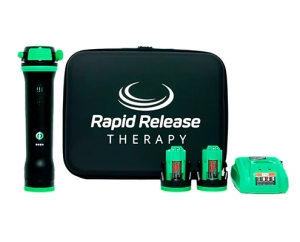
Rapid Release Pro
Stuck Muscles (And Why Deep Tissue Massage Isn’t Enough to Fix It)
You finished a hard workout, and your muscles feel tight. Not the good kind of tired—the kind where it feels like your muscles are locked in a state of constant tension. You stretch. You foam roll. You even get the occasional deep tissue massage.
It helps. Temporarily.
But within 24-48 hours, the tightness is back. Your range of motion is limited. Your next workout suffers because you’re compensating for the previous day’s tension. You feel like you’re perpetually one step behind recovery.
Here’s what’s actually happening at the tissue level: your muscles haven’t fully released. You have adhesions—places where muscle fibers are basically stuck together. You have scar tissue from microtears that never fully healed. You have trigger points where the nerve signal is telling your muscle to stay in a guarded, protective state.
Traditional stretching and foam rolling can’t fully address these issues because they don’t access the frequency required to dissolve adhesions and reset the muscle spindle.
But high-frequency vibration therapy can.
The Neuromuscular Problem Nobody Explains
Here’s the neurobiology that most people don’t understand: muscle tightness isn’t just mechanical. It’s neurological.
Your muscles contain specialized sensory organs called muscle spindles and the Golgi tendon organ. These are literally your body’s tension sensors. When you experience stress, intense exercise, or injury, your nervous system triggers these spindles to contract—to “guard” the muscle against further damage.
This protective mechanism is intelligent. Your body is trying to stabilize and protect. But the problem is that once this guarding response is activated, your nervous system often forgets to turn it off.
You end up with muscles that are chronically contracted, even when there’s no actual threat. You have what’s called “muscle guarding”—your muscles are literally locked in a protective state.
You can’t stretch this away. Stretching actually sometimes makes it worse because your muscle spindle interprets the stretch as a further threat and contracts even more to protect.
You can’t foam roll your way out of it either, because foam rolling addresses surface tension but doesn’t access the deep neurological patterns that are keeping the muscle locked.
What you need is a frequency-specific stimulus that tells your nervous system: “The threat is over. You can relax now.”
That frequency is what Rapid Release Pro 3 delivers.
How High-Frequency Vibration Actually Works
The Rapid Release Pro 3 operates at approximately 10,000 vibrations per minute—which translates to about 150 impacts per second.
This is the critical detail: it’s not just vibration. It’s high-frequency vibration with a short stroke and low amplitude.
This specific combination—high speed, short distance, low force—is engineered to target exactly what needs to be addressed: scar tissue adhesions and muscle guarding patterns.
Here’s the mechanism:
When you apply this high-frequency vibration directly to a muscle, it stimulates the muscle spindle in a very specific way. The rapid, rhythmic input essentially says to your nervous system: “This muscle is stable. The threat has passed. You can reduce the guarding response.”
Your nervous system hears this signal, and the muscle relaxes. Not through force—through neurological permission.
At the same time, the vibration frequency is precisely calibrated to target scar tissue. Unlike percussion massage (which uses heavy, slower impacts that go deep but can be aggressive), Rapid Release’s short-stroke, high-frequency approach breaks apart adhesions in a way that’s both effective and comfortable.
Athletes and therapists who’ve used traditional percussion massage devices report that Rapid Release is different. It’s not painful. It’s more targeted. And it works faster.
Why This Changes Everything for Recovery
The implications of this are huge, especially if you train hard or deal with chronic tension.
First, you get faster recovery. One of the most common reports from people using Rapid Release is that recovery time is cut significantly. Instead of 48-72 hours of persistent soreness and tightness, many people report substantial relief within 24 hours—or even after a single 3-minute session.
This isn’t just about comfort. Faster recovery means you can train harder more frequently. You’re not limited by the accumulated tension from previous sessions.
Second, you get increased mobility and range of motion. When your muscles are in a chronic guarding state, your range of motion is limited. Your nervous system is literally restricting how far you can move because it perceives danger. When Rapid Release resets the nervous system’s threat assessment, that range of motion returns—often immediately noticeable within minutes of treatment.
Third, you get performance improvements. You can lift heavier. You can move faster. You can endure longer. Because you’re not fighting against your own muscles’ protective tension.
Fourth, you address the actual problem, not just the symptom. Foam rolling and stretching feel good temporarily, but they’re often just managing symptoms. Rapid Release actually addresses the underlying issue: the nervous system’s guarding response and the adhesions that result from it.
The Different Treatment Heads and Why That Matters
The Pro 3 comes with five integrated treatment heads—you don’t swap attachments, which is crucial because it makes the device actually usable consistently.
The soft tip is for sensitive areas—around joints, bony prominences, anywhere you need gentler input.
The actuator tip is specifically designed for acupoints, trigger points, and smaller muscle groups. This is where you apply focused, targeted therapy to problem areas.
The treatment cap provides soothing, gentle therapy over large areas. This is your go-to for general relaxation and recovery.
The power band is for serious work. Large muscle groups. Particularly tight areas. When you need aggressive but controlled tissue release.
The large treatment head offers a broad surface area for general use or sensitive trigger points.
The genius is that you can use the side of the treatment head for broader coverage, the tips for pinpoint accuracy, and different areas of the device for different types of therapy—all without swapping anything.
This design means you actually use it, consistently, because it’s frictionless. You don’t have to find the right attachment. You don’t have to worry about losing pieces. You just grab it and treat.
How to Actually Use This for Maximum Effect
The protocol is simple but specific.
For most people, 3 minutes on a problem area produces noticeable results. You’re not looking for hours of treatment. High-frequency vibration therapy works in short, intense bursts.
Here’s the typical approach:
For acute soreness (post-workout tightness): Use 3-5 minute sessions starting 2-4 hours after intense exercise. Target the areas that feel most restricted. The device comes with variable speeds—most people find around 8,000-10,000 vibrations per minute optimal, but you can start lower and adjust based on comfort.
For chronic tension (long-standing tightness): Use daily 3-5 minute sessions, focusing on your problem areas. Most people notice significant improvement within 3-5 days of consistent use.
For trigger points: Apply the actuator tip directly to the point of maximum tenderness and hold for 30-60 seconds. The sensation is initially intense but releases quickly as the trigger point resolves.
For general recovery: A 3-minute session post-workout on major muscle groups—quads, hamstrings, back, shoulders—maintains flexibility and prevents the chronic tightness that accumulates.
The key is consistency and precision. You’re not trying to use this for hours. You’re using it strategically, targeting specific problems, and letting the high-frequency vibration do the neurological and tissue-level work.
The Difference Between Percussion and Rapid Release
This is an important distinction because there are a lot of percussion massage devices on the market, and they’re not the same thing.
Percussion massage uses heavy, slower impacts—typically 1,200-3,000 beats per minute. It goes deep and can be very effective for certain applications. But it’s slower, heavier, and uses a longer stroke.
Rapid Release vibration therapy uses much higher frequency—up to 10,000 vibrations per minute—with a short stroke and low amplitude. It targets the surface and intermediate layers but with much higher frequency.
The different mechanisms make them suited for different purposes:
Percussion is better for deep muscle work and breaking up significant knots. But it can be aggressive, sometimes uncomfortable, and the slower frequency doesn’t target the muscle spindle response as directly.
Rapid Release is better for nerve signal reset, adhesion breaking, and overall recovery because of the frequency specificity. It’s more comfortable. It’s more portable. It accesses the neurological mechanism that percussion doesn’t reach as directly.
Most athletes find that Rapid Release is better for daily recovery and maintenance, while percussion is better for occasional deep tissue work.
What Changes When You Use It Consistently
Here’s what consistent users report after a few weeks:
Better sleep: Tension dissolution means your nervous system is less activated. People fall asleep faster and sleep deeper.
Improved mood: Chronic muscle tension is a form of chronic stress. Releasing that tension actually improves mood and mental clarity.
Better workout performance: The next day’s workout feels better. Your range of motion is better. You can push harder because you’re not fighting against yesterday’s residual tension.
Fewer injuries: This is subtle but important. Many injuries happen because compensatory patterns develop from unresolved tension. When you address tension systematically, you reduce compensation, which reduces injury risk.
Greater flexibility: Not the flexibility that comes from stretching, but the genuine mobility that comes from your nervous system allowing full range of motion.
Less reliance on other recovery tools: People often find they need less stretching, less foam rolling, less icing, less massage. One targeted tool becomes more effective than five mediocre ones.
The Practical Realities
The Pro 3 is cordless with excellent battery life, making it genuinely portable. You can use it at home, at the gym, while traveling, anywhere.
It’s designed to be used with or without a practitioner—meaning you can self-treat, or a therapist can use it as part of their practice.
It’s an FDA-registered Class 1 medical device, which means it’s been validated for safety and effectiveness.
The industrial-grade construction means it’s built to last. You’re not buying something that will break after a year. This is professional equipment.
And the 100-day trial period (with a 15% restocking fee for consumers, no fee for healthcare providers) means you can test it risk-free and see if it’s the right tool for you.
Why This Matters More Than Just “Feeling Better”
Yes, relief from tightness feels good. But the deeper benefit is that you’re addressing a neurological problem—muscle guarding—that affects everything downstream.
When your muscles are chronically guarded, your whole body is operating under a false threat assessment. Your nervous system thinks there’s danger, so it’s constantly in a protective state. This limits your performance, increases your injury risk, and creates a baseline of tension that you’ve probably accepted as normal.
Rapid Release resets that threat assessment. It tells your nervous system: “You’re safe. The muscle is stable. You can relax.”
Over time, with consistent use, your body learns new baseline. Your resting tension decreases. Your accessible range of motion increases. Your performance improves because you’re no longer fighting against your own protective mechanisms.
This is why athletes who adopt Rapid Release as a consistent tool often report that it’s one of the most impactful investments they’ve made in their performance and recovery.
The Bottom Line
You probably don’t realize how much of your limited range of motion, persistent soreness, and performance ceiling is due to unresolved muscle guarding and adhesions.
Traditional stretching and foam rolling don’t fully address these issues because they don’t access the neurological mechanism (muscle spindle response) or target the specific frequency required to break adhesions.
Rapid Release Pro 3 does both. 10,000 vibrations per minute, high-frequency, short-stroke, precisely engineered to reset your nervous system’s threat assessment and break apart the adhesions keeping you locked in tension.
Three minutes a day targeting your problem areas. That’s it. Not hours. Not expensive regular massage. Just strategic, neurologically-informed tissue work.
Within days you’ll feel the difference. Your mobility will improve. Your soreness will decrease. Your next workout will feel better because you’re not dragging yesterday’s unresolved tension into today.
Within weeks, people often report that this single tool has done more for their recovery and performance than months of other approaches.
If you train hard, deal with chronic tension, or want to optimize your recovery, this is worth trying. Especially with the 100-day trial period—you can test it risk-free and experience firsthand why thousands of athletes and therapists have made this part of their standard toolkit.
Check out Rapid Release Pro 3 and commit to a consistent 30-day protocol. Use it 3 minutes daily on your major problem areas. Track your mobility and soreness.
You’ll be surprised by how much changes when you address the actual neurological mechanism keeping you stuck instead of just managing the symptoms.
Your nervous system will finally get permission to relax.
Important Disclaimer: The Rapid Release Pro 3 is an FDA-registered Class 1 medical device. While the research on high-frequency vibration therapy is promising and user testimonials are extensive, individual results vary. This device is not intended to diagnose, treat, cure, or prevent any disease. Always consult with a healthcare provider before using any therapy device, especially if you have active inflammation, acute injuries, or implanted medical devices. Use as directed and follow all safety guidelines provided.
A Note on Transparency: I recommend recovery tools based on scientific mechanisms and genuine user outcomes. This post includes affiliate information. If you purchase through the provided links, I earn a commission. That said, I specifically recommend Rapid Release because the neurological mechanism behind high-frequency vibration therapy is sound, the device is professionally-grade, and user testimonials consistently report meaningful improvements in mobility, recovery speed, and performance—outcomes that align with what the science predicts.
