
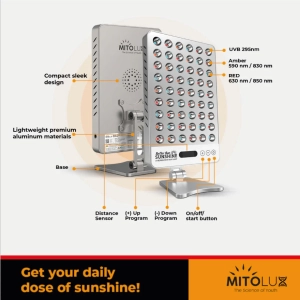
Explore the Mitolux panel for effective UV light therapy in a compact design
The Mitolux Sunlamp Supplies The Light Your Cells Have Been Starving For
Here’s a statistic that should genuinely disturb you: the average American spends approximately 90% of their life indoors under artificial lighting.
Ninety percent.
Think about that for a moment. You evolved in sunlight. Every system in your body—your circadian rhythms, your vitamin D synthesis, your mitochondrial function, your mood regulation, your hormone balance—was designed for natural light. And now you’re spending the vast majority of your existence under flickering fluorescent bulbs and blue-light-emitting screens.
Your body doesn’t know what to do with this. It’s in a state of constant malfunction, trying to operate in an environment it was never designed for.
And the consequences are everywhere: epidemic levels of vitamin D deficiency, sleep disorders, depression, mitochondrial dysfunction, hormonal chaos, and a general feeling that something is fundamentally wrong with how you’re experiencing energy and vitality.
The problem isn’t you. The problem is light.
Why Your Mitochondria Are Basically Screaming for Help
Let me explain what’s actually happening at the cellular level.
Your mitochondria—those cellular power plants we talked about before—don’t just need NAD and PQQ to function optimally. They need specific wavelengths of light.
This isn’t some fringe biohacking concept. This is basic photobiology.
The mitochondria contain chromophores—light-absorbing molecules—that respond to specific wavelengths. When red and near-infrared light (particularly at wavelengths around 600-1000 nanometers) hits your mitochondria, it stimulates the electron transport chain and accelerates ATP production.
This is called photobiomodulation, and it’s one of the most direct ways to increase your mitochondrial output.
Here’s what happens:
Red light at wavelengths around 630 nanometers penetrates deep enough to reach your mitochondria and stimulates the enzyme cytochrome c oxidase. Near-infrared light at 830-850 nanometers goes even deeper into muscles, joints, and connective tissue. These wavelengths literally tell your mitochondria to produce more energy.
But that’s just one part of the equation.
You also need UVB light to synthesize vitamin D. Not the UVA rays that cause skin damage and aging—those should be eliminated. Just the UVB spectrum at 295 nanometers that triggers your skin to produce cholecalciferol (vitamin D3).
Vitamin D isn’t just about bone health. It’s a hormone that regulates your immune system, your mood, your testosterone levels, your circadian rhythm, and your inflammatory response. Deficiency in vitamin D is linked to virtually every major disease and every mood disorder.
When you’re getting 90% of your light from indoor artificial sources, you’re getting basically zero UVB and almost zero beneficial red/infrared light. You’re in a state of chronic light malnutrition.
Why Supplements Aren’t Solving This
Here’s the uncomfortable truth about vitamin D supplementation: it’s not the same as producing it yourself.
When you take a vitamin D3 supplement, you’re getting the end product. It works, somewhat. But when you produce vitamin D through light exposure, something different happens. The process isn’t just biochemical—it’s systemic.
The UVB exposure that triggers vitamin D synthesis also triggers the production of other neuroendocrine peptides like POMC (pro-opiomelanocortin), alpha-MSH, and beta-endorphins. These are powerful mood-regulating and immune-regulating compounds that you simply don’t get from a pill.
There’s also the circadian rhythm component. Natural light exposure, particularly UVB in the morning, sets your circadian clock. It tells your brain “it’s morning, time to wake up.” It suppresses melatonin. It entrains your entire nervous system to the 24-hour cycle that your body actually understands.
You can’t get this from a supplement. You can’t get it from a meditation app. You need actual light exposure.
But here’s the problem: most people can’t get outside enough to get adequate light. They live in climates with limited sun. They work indoors. They’re covered in sunscreen that blocks UVB. By the time they realize they’re vitamin D deficient, they’re severely depleted.
And most vitamin D lamps on the market are either ineffective or dangerous—they either don’t put out enough UVB to matter, or they include harmful UVA rays that damage your skin.
That’s where MitoLux comes in.
What Makes This Different From Just Going Outside
MitoLux is a “better than sunshine” lamp that delivers the beneficial parts of sunlight while eliminating the harmful parts.
The device uses 295-nanometer narrowband UVB—the exact wavelength that clinical research shows is most effective for stimulating vitamin D synthesis in your skin. This is important. Most UVB lamps use broader spectrum UVB that includes less effective wavelengths. MitoLux engineered their technology specifically around the wavelength that matters.
But it’s not just UVB. The lamp also incorporates multiple wavelengths of red and near-infrared light: 590nm amber light for lymphatic drainage and skin repair, 630nm red light for collagen synthesis and cellular rejuvenation, and 830nm and 850nm near-infrared for deep tissue penetration and mitochondrial stimulation.
Here’s the elegant part: the lamp is designed to mimic the sun’s natural cycle. Sessions begin and end with red and infrared light that prepares and protects your skin. The UVB exposure happens in the middle, sandwiched between protective wavelengths.
And unlike normal sun exposure, the lamp eliminates harmful UVA rays entirely. You get all the benefits of sunlight—vitamin D synthesis, mitochondrial stimulation, circadian rhythm entrainment, hormone production—without the skin damage, premature aging, and oxidative stress that comes from UVA exposure.
This is important. Traditional sun exposure gives you the vitamin D, yes, but you also get the wrinkles, the age spots, the increased skin cancer risk. MitoLux delivers the benefits without the damage.
What Actually Happens When You Start Using It
Most people report noticeable effects within the first week, though the changes are subtle at first.
Your mood lifts. This isn’t placebo—it’s the combination of serotonin production from light exposure and the neuroendocrine cascade triggered by UVB. People report feeling more “present,” less foggy, more motivated.
Your sleep improves. The light exposure in the morning resets your circadian rhythm. Your melatonin production normalizes. You fall asleep faster and sleep deeper.
Your skin looks better. The red light stimulates collagen production and cellular repair. You look more vibrant, more “glowing.” This typically becomes obvious around 2-4 weeks of consistent use.
Around 6 weeks, if you get blood work done, your vitamin D levels show measurable improvement. One user went from supplementing with vitamin D3 and measuring at 50-60 ng/mL to reaching 99 ng/mL—optimal range—without any supplements, just using the lamp daily.
Your energy levels improve. The mitochondrial stimulation from the red/infrared light and the combined effect of better vitamin D, better sleep, and better circadian rhythm all contribute to feeling genuinely more energized. Not the jittery energy of caffeine, but the sustained energy of cells actually producing ATP efficiently.
Your mood stabilizes. The combination of light exposure, vitamin D synthesis, and neuroendocrine peptide production means people consistently report lower anxiety, better emotional resilience, and improved mood.
Some people report increased libido and better sexual performance, likely due to improved testosterone levels and mitochondrial function.
The Honest Timeline and Realistic Expectations
This isn’t a quick fix. You won’t use it once and feel dramatically different.
But consistent daily use does produce measurable, noticeable changes:
Week 1-2: Subtle mood lift, slightly better sleep, skin looks fresher. You might wonder if it’s placebo.
Week 3-4: Sleep is noticeably better. Mood is more stable. Energy is more consistent. People around you might comment that you look well.
Week 6+: Vitamin D levels show measurable improvement. Skin tone is visibly better. Energy levels are genuinely higher. You feel different in your body.
3 months: The compounding effects become obvious. Your circadian rhythm is reset. Your baseline mood is improved. Your skin is healthier. Your energy is more sustainable throughout the day.
The key is consistency. You need to use it daily. The protocol is simple—as little as 30 seconds to 2 minutes a day can produce measurable vitamin D—but it needs to be part of your routine, not something you do occasionally.
The Models and Practical Considerations
MitoLux offers different versions depending on your needs and budget.
The MitoLux LITE is the more affordable, more portable option. It’s under $500, compact enough to fit on a desk, and delivers five optimized wavelengths for vitamin D and red light therapy. It has preset programs that make it foolproof—you just press a button and let it work.
The MitoLux BTS2 (Better Than Sunshine 2) is the flagship model. It’s more powerful, has 14 customizable modes, offers more wavelength options, and includes safety features like a proximity sensor and customizable UVB intensity levels based on your skin tone. It’s a more complete light therapy system.
Which one you choose depends on your situation:
If you want simplicity and portability, the LITE is fantastic value and does exactly what you need.
If you want maximum flexibility, deeper penetration, and more therapeutic options, the BTS2 is worth the investment.
Either way, the usage is straightforward. You apply a thin layer of conductive gel to your neck or the area you’re treating (the gel helps light penetration slightly), position the lamp at the appropriate distance, select your mode, and let it run.
Sessions are short—often 3-5 minutes—making it easy to integrate into your morning routine.
Why This Matters More Than You Probably Realize
Modern wellness culture is obsessed with supplements and biohacking protocols. Take this stack. Optimize this. Measure that.
But we’re missing the most fundamental input: light.
You literally evolved in sunlight. Your entire physiology is calibrated for natural light exposure. Every system in your body—circadian, endocrine, immune, mitochondrial—relies on light signals to function optimally.
And for the past 100 years, we’ve systematically eliminated that input from human life.
MitoLux is one way to restore what we’ve lost. It’s not a substitute for actual sunlight when you can get it. But for the 90% of your time that you’re indoors, it’s the most direct way to give your cells the light input they’re designed to receive.
It’s one of those interventions where the ROI on your health is genuinely exceptional. A few minutes a day. Better mood, better sleep, better energy, better skin, better vitamin D, better mitochondrial function.
No pills. No complex protocols. Just light.
The Bottom Line
You’re in a darkness crisis, and your body knows it. Your mitochondria are screaming for the wavelengths they evolved to receive. Your circadian rhythm is dysregulated because you’re treating day and night the same way. Your vitamin D is depleted because you’re not getting UVB exposure.
You can keep supplementing. Keep trying to meditate your way to calm. Keep wondering why you feel so fundamentally exhausted despite sleeping enough and optimizing everything else.
Or you can restore what your cells have been missing: proper light.
MitoLux doesn’t require belief. It doesn’t require willpower. It just requires you to sit in front of a light source for a few minutes a day and let your cells do what they’re designed to do.
Within weeks, you’ll feel the difference. Your mood will lift. Your sleep will deepen. Your energy will stabilize. Your skin will glow.
And you’ll realize how much of what felt broken about your health was actually just your cells starving for light.
If you’re ready to restore what modern life has taken away, check out MitoLux Sunlamp and start with a consistent daily practice. Pick a time—morning is ideal for circadian rhythm benefits—and commit to it for 30 days.
Your mitochondria will thank you. Your mood will thank you. Your future self will definitely thank you.
This is what it feels like when your cells finally get what they’ve been missing.
Important Disclaimer: These statements have not been evaluated by the Food and Drug Administration. MitoLux lamps are not medical devices and are not intended to diagnose, treat, cure, or prevent any disease. While light therapy research is promising, individual results vary based on factors including skin type, proximity to the lamp, and consistency of use. Always consult with a healthcare professional before starting light therapy, especially if you have photosensitivity, are pregnant, or are taking medications that may increase light sensitivity. Use as directed and follow all safety guidelines provided.

