
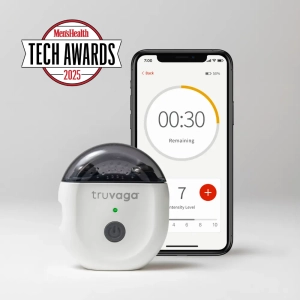
Truvaga Plus
Two Minutes That Could Change Everything: Why Your Vagus Nerve Is the Most Powerful Tool You’re Ignoring
You’re sitting at your desk at 2 PM and your chest feels tight. Your email dings and your heart rate spikes. You haven’t slept well in months. Your stomach is constantly in knots. You’re snapping at people over small things. And no matter what you do—meditation, yoga, exercise—something feels fundamentally off.
You’re probably blaming yourself. Assuming you’re not disciplined enough, not resilient enough, not enough in some fundamental way.
But the actual problem might be simpler than that: your vagus nerve is asleep.
The Nerve That Controls Everything (And Why Nobody Talks About It)
Your vagus nerve is the longest nerve in your body. You have two of them—one running down each side of your neck—and they’re literally the communication highway between your brain and every major organ: your heart, your lungs, your digestive system, your immune system.
This nerve isn’t like other nerves. It’s the master control system for something called your autonomic nervous system—the automatic functions you don’t think about. Your heart rate. Your digestion. Your inflammatory response. Your stress response.
But here’s the critical part: your vagus nerve operates in two modes.
Mode 1 is “fight or flight” (sympathetic activation). Your stress response. Your survival instinct. It was designed for genuine emergencies—a predator chasing you, immediate danger. In that mode, your digestion shuts down, your heart rate spikes, your immune system gets suppressed, your focus narrows to survival.
Mode 2 is “rest and digest” (parasympathetic activation). This is your recovery mode. Your healing mode. It’s when your digestion works, your immune system is strong, your nervous system is balanced, your stress hormones normalize.
The problem is that modern life keeps your vagus nerve stuck in fight-or-flight.
Chronic emails. Financial stress. Health anxiety. Sleep deprivation. Social conflict. Information overload. Your nervous system is literally experiencing the same chemical cascade as a human running from a tiger—except it never stops. The tiger is your inbox. The predator is your mortgage.
After months or years of this, your vagus nerve loses its tone. It becomes weak at signaling “you are safe” to your body. Your nervous system gets locked in dysregulation. And you become the person who can’t sleep, can’t digest properly, can’t think clearly, gets worked up easily, and feels like something is fundamentally wrong.
Because something is wrong—but it’s not you. It’s your vagal tone.
Why Willpower Can’t Fix This
This is where most wellness approaches fail.
You think the solution is to try harder. Meditate more. Exercise more. Sleep more. Get your life together. And while all of those things have value, they’re trying to convince your nervous system to relax using cognitive tools.
Your thinking brain is saying: “I am safe.”
But your nervous system—which operates below consciousness—is saying: “I am in danger.”
And your nervous system always wins. Your thinking brain can’t argue with what your body is experiencing.
This is why someone can logically understand that their boss’s criticism isn’t personal, but their body still floods with shame and panic. Or why someone can know they’re safe, but their heart won’t slow down. Or why someone can be lying in a safe bed but can’t fall asleep because their nervous system is convinced it needs to stay vigilant.
You can’t meditate your way out of a dysregulated nervous system. You need to speak directly to your nervous system in the language it understands.
That language is stimulation.
How Your Vagus Nerve Actually Gets Trained
Here’s the neurobiology that most people don’t understand: your vagus nerve is a muscle. Actually, it’s a nerve, but it functions like a muscle in one crucial way—it can be trained and strengthened.
When you stimulate your vagus nerve directly, you’re not trying to think your way to calm. You’re literally training your nervous system to recognize and activate its parasympathetic response.
It’s like this: imagine your vagus nerve is a conductor of an orchestra. When it’s strong and healthy, it conducts your nervous system beautifully—you go into stress mode when there’s actual stress, then smoothly transition back to rest mode when the stress passes.
But when your vagus nerve is weak from years of chronic stress, the conductor loses control. The orchestra is stuck playing the same anxious, frantic piece over and over. It can’t hear the signal to calm down.
Vagus nerve stimulation is like giving that conductor a direct channel to every instrument in the orchestra, saying: “Okay, everyone. The emergency is over. Return to your baseline.”
Your nervous system hears this repeated signal and slowly retrains itself. “Oh, this is what calm feels like. This is the signal for safety.”
What Truvaga Actually Does
Truvaga is a handheld device that delivers gentle electrical stimulation directly to your vagus nerve at the neck.
It’s small, portable, and remarkably simple. You apply a thin layer of conductive gel or spray to the side of your neck where your vagus nerve runs (the same spot where you’d find your pulse). You place the device on your neck. You adjust the intensity until you feel a gentle tingling or a slight muscle contraction at the corner of your mouth. That’s how you know you’re in the right position.
Then you wait two minutes. That’s the entire session.
What’s happening during those two minutes is this: the device is sending 5,000Hz electrical pulses to your vagus nerve, which directly activates your parasympathetic nervous system and triggers what researchers call the “inflammatory reflex”—a mechanism that reduces pro-inflammatory markers and tells your immune system to calm down.
Your heart rate variability improves. Your stress hormones begin normalizing. Your nervous system gets a clear signal: “Okay, we can relax now. The threat has passed.”
And here’s the elegant part: because you’re doing this consistently—ideally twice a day, morning and evening—your nervous system slowly rewires. After a few weeks of consistent stimulation, your baseline anxiety starts dropping. Your sleep improves. Your digestion normalizes. Your emotional reactivity decreases.
The Timeline: When You Actually Start Feeling Different
Most people report noticing something within the first few days, but it’s subtle. They might sleep slightly better. Feel a tiny bit calmer. You might think it’s placebo.
Then around day 7-10, if you’re consistent with twice-daily sessions, something shifts. The baseline anxiety that you’d gotten so used to you didn’t even notice it anymore—it lifts. Just a bit. But noticeably.
By day 30 of consistent use, the changes become undeniable. People report better sleep. Lower stress. Improved mood. Better digestion. Fewer heart palpitations. Less reactivity to small stressors.
But here’s the important part: this isn’t a quick fix. You’re not taking this for two weeks and expecting a permanent cure. This is nervous system retraining. You’re teaching your vagus nerve to do something it’s forgotten how to do—activate relaxation on command.
Some people see benefits within 2-3 weeks. Others need 4-6 weeks of consistent use before the shift becomes obvious. And the earlier you start the better the results—because the longer your vagus nerve has been dysregulated, the longer it takes to retrain.
There’s research backing this. Studies on vagus nerve stimulation show PTSD symptom reduction by up to 40% in 6 weeks. Anxiety improvements. Sleep improvements. Mood stabilization. And these aren’t small effects—people who’ve used VNS devices report it being among the most effective wellness tools they’ve tried.
Two Versions, Same Principle
Truvaga comes in two versions.
Truvaga 350 is the original—a simple, cordless device preloaded with 350 two-minute sessions. No app, no charging, no complexity. You take it out, use it, and when all 350 sessions are done (which gives you roughly 6 months of twice-daily use), you order a new one. It’s elegant in its simplicity.
Truvaga Plus is the upgraded version. It’s rechargeable, app-enabled, and designed for unlimited use (at least 30,000 sessions guaranteed for 3 years). The app lets you track your progress, schedule sessions, and monitor how you’re improving over time. It integrates with Apple Health for a complete wellness picture.
The choice between them comes down to your preference. Do you like simplicity and want zero complexity? Truvaga 350. Do you want data tracking and a premium experience? Truvaga Plus.
Either way, you get the same fundamental benefit: direct, non-invasive vagus nerve stimulation in two-minute increments.
Who Actually Needs This
If you’re constantly stressed—even when there’s nothing objectively stressful happening—your vagus nerve is probably dysregulated.
If you sleep poorly—even when you’ve optimized everything else—your nervous system might be stuck in fight-or-flight.
If you get anxious over small things—emails, social situations, minor setbacks—your vagal tone is likely compromised.
If you have digestive issues that don’t respond to diet changes, that’s often a sign of a dysregulated vagus nerve (which controls your parasympathetic digestion response).
If you’ve been through trauma or chronic stress and even though the stressor is gone, your body hasn’t relaxed, your vagus nerve probably hasn’t reset.
If you’re a high performer who needs mental clarity and emotional resilience, strengthening your vagal tone is one of the most direct ways to improve your stress response capacity.
If you meditate but feel like you hit a ceiling—like your nervous system just won’t fully relax—it’s because meditation alone doesn’t directly stimulate the vagus nerve the way electrical stimulation does.
The honest answer is: if you’re a human living in modern times with chronic stress, your vagal tone is probably below optimal. Vagus nerve stimulation isn’t luxury wellness. It’s nervous system maintenance.
Why This Works When Other Things Don’t
There’s something important to understand about nervous system dysregulation: it’s not a cognitive problem. It’s not something you think your way out of.
You can understand logically that you’re safe. Your nervous system won’t believe you until your body experiences it.
That’s the power of Truvaga—it bypasses all the cognition and speaks directly to your nervous system. Your body feels the stimulation. Your vagus nerve receives the signal. Your parasympathetic nervous system activates. Your stress hormones normalize.
It’s not about willpower or discipline or understanding. It’s about physiology.
And that’s why people often see faster improvements with vagus nerve stimulation than they do with months of therapy or meditation. Because you’re not trying to convince your thinking brain. You’re retraining your nervous system’s baseline.
The Practical Reality
The device is small and portable. The sessions are exactly 2 minutes. You’re using conductive gel or spray that’s inexpensive and lasts months.
For optimal results, the recommendation is one session in the morning and one before bed. That’s 4 minutes a day of active use.
Some people feel comfortable going up to 24 sessions per day if they’re in acute stress or early in their retraining—the device is designed to be safe with unlimited daily use.
The intensity is adjustable, so you control how strong the stimulation is. You’re aiming for a level where you feel a clear tingling sensation or a slight muscle contraction (the “lip pull” that some people report). But even if you can’t quite feel those sensations, the device is still working.
There are minimal side effects for most people. Some report mild tingling that lasts a few seconds after the session. Some report the lip contraction is initially startling (it’s not painful, just an unfamiliar sensation). These typically resolve quickly as your nervous system gets used to the input.
The Cost-Benefit That Actually Matters
Let’s be real about the economics here.
You can spend hundreds on therapy sessions. Thousands on supplements trying to manage anxiety. Hundreds on sleep consultants. Years trying different meditation practices.
Or you can invest in a device that directly addresses the root cause: your vagus nerve’s ability to activate relaxation.
The device costs around $300-500 depending on which model you choose. The conductive medium costs about $45 per year.
Compare that to ongoing therapy, medication side effects, lost productivity from brain fog, sleep deprivation, and the general quality-of-life cost of being in chronic stress.
The ROI on nervous system function is extraordinary.
The Bottom Line
Your vagus nerve is like the vagus system of your entire autonomic nervous system. When it’s strong, everything else gets easier. Sleep improves. Stress resilience increases. Digestion normalizes. Mood stabilizes. Thinking clears. Recovery speeds up.
When it’s weak, nothing else compensates. You can optimize everything else and still feel fundamentally dysregulated because your nervous system baseline is off.
Truvaga gives you a way to directly retrain that baseline. Not through thinking or meditation or behavior change, but through direct physiological stimulation.
Two minutes a day. Twice daily. For 30 days. And you’ll know if your vagus nerve was the missing piece, because you’ll feel genuinely different.
Not superhuman. Just genuinely relaxed. Like your nervous system finally has permission to stop running. Like you’ve remembered what it feels like to be safe in your own body.
If you’re ready to stop fighting your nervous system and start actually training it, check out Truvaga and start with a 30-day committed practice. Try the morning and evening routine. Track what shifts. Notice your sleep. Observe your stress reactivity.
Your nervous system has been dysregulated for probably years. It might take more than two minutes to fully retrain. But if those two minutes, twice daily, can start shifting how you feel in your body—that’s not a supplement. That’s a nervous system reset.
And that changes everything.
Important Disclaimer: These statements have not been evaluated by the Food and Drug Administration. Truvaga is a medical device designed to support wellness and nervous system health. While research shows promise for vagus nerve stimulation, it is not intended to replace medical treatment for diagnosed psychiatric or medical conditions. If you have implanted electronic devices (pacemaker, hearing aids, etc.), a history of vagal issues, or any medical concerns, consult with your healthcare provider before using Truvaga. Truvaga should not be used on both sides of the neck simultaneously.
A Note on Transparency: I recommend wellness tools based on the science and genuine user outcomes. This post includes affiliate information. If you purchase through the links provided, I earn a commission. That said, I specifically recommend Truvaga because the research on vagus nerve stimulation is compelling, the user testimonials are remarkably consistent, and it addresses a root cause (vagal tone) that most people don’t realize is the source of their chronic stress and sleep issues.

